
The Golden Dome Problem
Congress funded Trump’s missile shield without knowing what it is, how it would work, or what it would cost.

I’m on the road this week, visiting my son at college in Santa Barbara. On Thursday, I stopped at the Ronald Reagan Presidential Library, which I highly recommend, especially for the chance to tour an actual Air Force One and a replica Oval Office.
Along with exhibits like the “Just Say No” board game and nostalgia for a leader known for his decency, there were reminders of the last time a US president promised a revolutionary missile-defense shield that critics said could not work.
Ronald Reagan’s Strategic Defense Initiative was widely mocked as “Star Wars.” It was never fielded. But it terrified the Soviets.
Trump’s Star Wars reboot, his “Golden Dome,” took center stage at Davos this week, as the president recast his earlier threat to seize Greenland as a matter of national security, arguing that the Danish island would play an undefined role in a next-generation missile-defense shield.
“All we want from Denmark, for national and international security and to keep our very energetic and dangerous potential enemies at bay, is this land on which we’re going to build the greatest golden dome ever built,” Trump said.
“If there is a war, much of the action will take place on that piece of ice,” he said. “Think of it. Those missiles would be flying right over the centre of that piece of ice.”
“You can’t defend it on a lease,” he added, even though the United States has operated an early-warning radar at Pituffik Space Base north of the Arctic Circle for decades under an agreement with Denmark.
It would be easy to dismiss this as another episode of Trumpian improvisation, another branding exercise masquerading as strategy or policy, except that Congress has already committed billions of dollars to a program it cannot even describe.
Trump signed an executive order for the Golden Dome in his first month back in office, and a few months later, Congress approved $24.4 billion, which the president called a “down payment” on the vast sums the program would eventually require.
A Shield without a Plan
Buried in this week’s conference report from House and Senate defense appropriators, however, was an extraordinary admission: lawmakers say they have no idea what they funded because the Pentagon has not explained what it plans to do.
“Due to insufficient budgetary information,” the House and Senate Defense Appropriations Subcommittees were “unable to effectively assess resources available to specific program elements and to conduct oversight of planned programs and projects for fiscal year.”
It’s one thing to fund a controversial program. It’s another thing to admit you funded something you can’t even evaluate.
What’s missing? There is no timeline for when anything would be built. No way to measure whether it would work or what it would cost. Not even a clear picture of what the system actually is, all of which Congress required by law for a program that Trump says will be completed before he leaves office.
Rep. John Garamendi, a California Democrat, has been warning about the Golden Dome “boondoggle” for months.
“We are concerned that Golden Dome will be much more effective at wasting taxpayer dollars than countering missile attacks,” Garamendi wrote in a July letter to Defense Secretary Pete Hegseth that was signed by a dozen other Democrats.
The Pentagon, meanwhile, continues to make expansive promises. Hegseth has said the Golden Dome “will progressively protect our nation from aerial attacks from any foe.”
Rewriting Nuclear Strategy
That sounds reassuring, if a bit expensive, with cost estimates for all-threat defense ranging up to $3.6 trillion.
But presumably “any foe” includes Russia and China, the only countries with nuclear arsenals capable of launching large-scale missile attacks on the United States. Defending against those arsenals would require a potentially destabilizing departure from longstanding US missile-defense policy.
For decades, our missile defense systems have focused on countering limited threats, such as a small number of missiles from, say, North Korea. US policy relies on deterrence—the threat of nuclear war—to address the arsenals of “near-peers” like Russia and China.
In the through-the-looking-glass logic of nuclear strategy, when both sides can destroy each other, nobody shoots first. But when one side thinks it can protect itself, that’s when things get dangerous. Now the other side has an incentive to strike before that shield is finished.
Congress seems to have noticed. In its latest defense authorization report, the Senate Armed Services Committee acknowledges that Golden Dome “potentially represents a profound shift in how the United States deters and defends against missile and aerial threats to the homeland.”
That’s assuming the system would actually work.
As anyone who watched the Netflix thriller A House of Dynamite knows, the limited missile-defense system the United States already has does not inspire much confidence.
A Coin Toss
Directed by Kathryn Bigelow and written by Noah Oppenheim, the film—spoiler alert!—imagines a scenario where US missile defenses fail to knock down a single nuclear-tipped intercontinental ballistic missile headed for Chicago.

In one of the film’s best scenes, the defense secretary, played by Jared Harris, loses it when he learns that current US missile defenses have only a slightly better than 50–50 chance of intercepting an incoming missile.
“So it’s a fucking coin toss? That’s what $50 billion buys us?” Harris says.
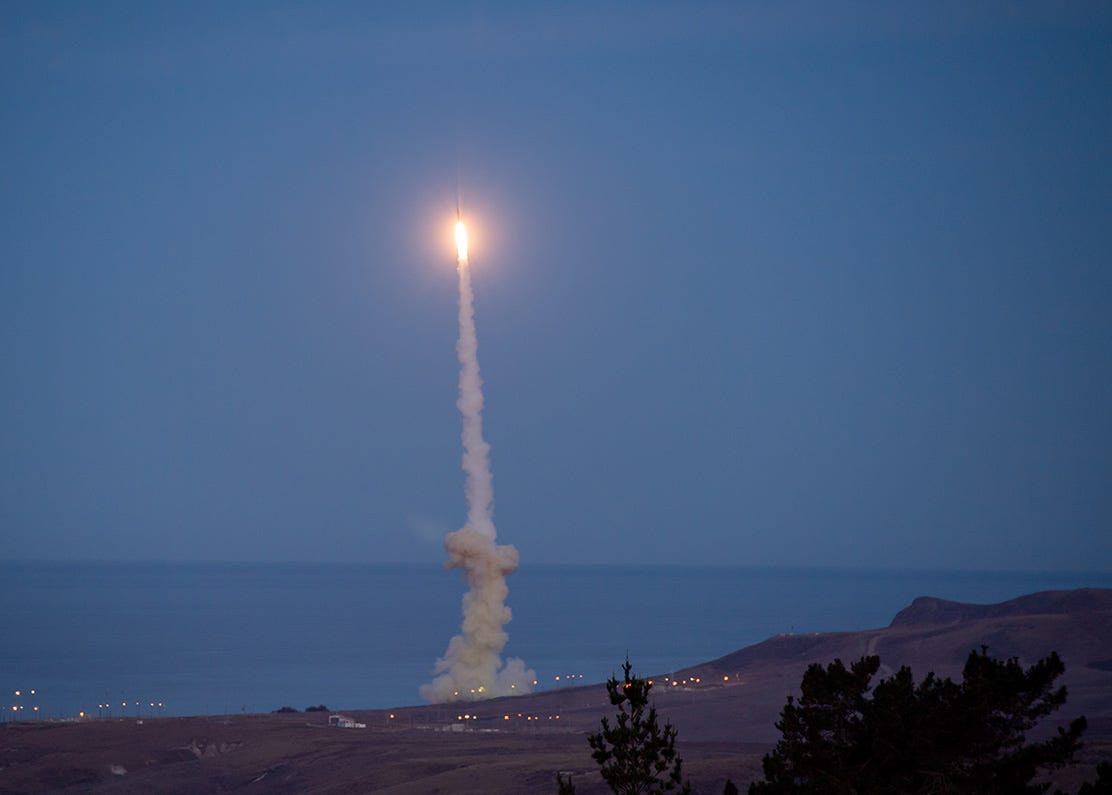
That line caused some heartburn at the Missile Defense Agency, which has spent more than $50 billion on a system of ground-based interceptors in Alaska and California and is now being asked to scale that system up to something far larger. According to a memo obtained by Bloomberg, the agency claims today’s interceptors “have displayed a 100 percent accuracy rate in testing for more than a decade.”
Outside experts say those numbers are too good to be true. Laura Grego of the Union of Concerned Scientists said the coin-toss analogy is closer to reality, even for the simplest and least sophisticated attack scenario depicted in the film.
Over the past 25 years, Grego noted, there have been 20 interceptor tests, and even under simplified conditions, the system failed roughly half the time.
Reliability has increased over the years, but Grego likened US missile-defense testing to “T-ball practice when the real world is major league baseball.” In real conflicts, attacks would include salvos of missiles, decoys, and countermeasures designed to confuse and overwhelm defenses. Even countries like Iran or North Korea would not simply lob a single, clean missile and hope for the best.
If the United States struggles to hit a ball off a tee, what exactly would we be buying for $3.6 trillion: a shield that doesn't work, or one that doesn't exist?
“Congress funded Trump’s missile shield without knowing what it is, how it would work, or what it would cost.” Well we know more about it than we do the 600b- 1 trillion and fraud every year. I’m more worried about that… and so should congress.
I believe that "Golden Shower" is perhaps a more appropriate name.