
Inside the Classified Whistleblower Complaint Against America's Spy Chief (UPDATED)
White House invoked executive privilege to redact portions of complaint alleging Tulsi Gabbard restricted an NSA report involving a Trump associate for political reasons

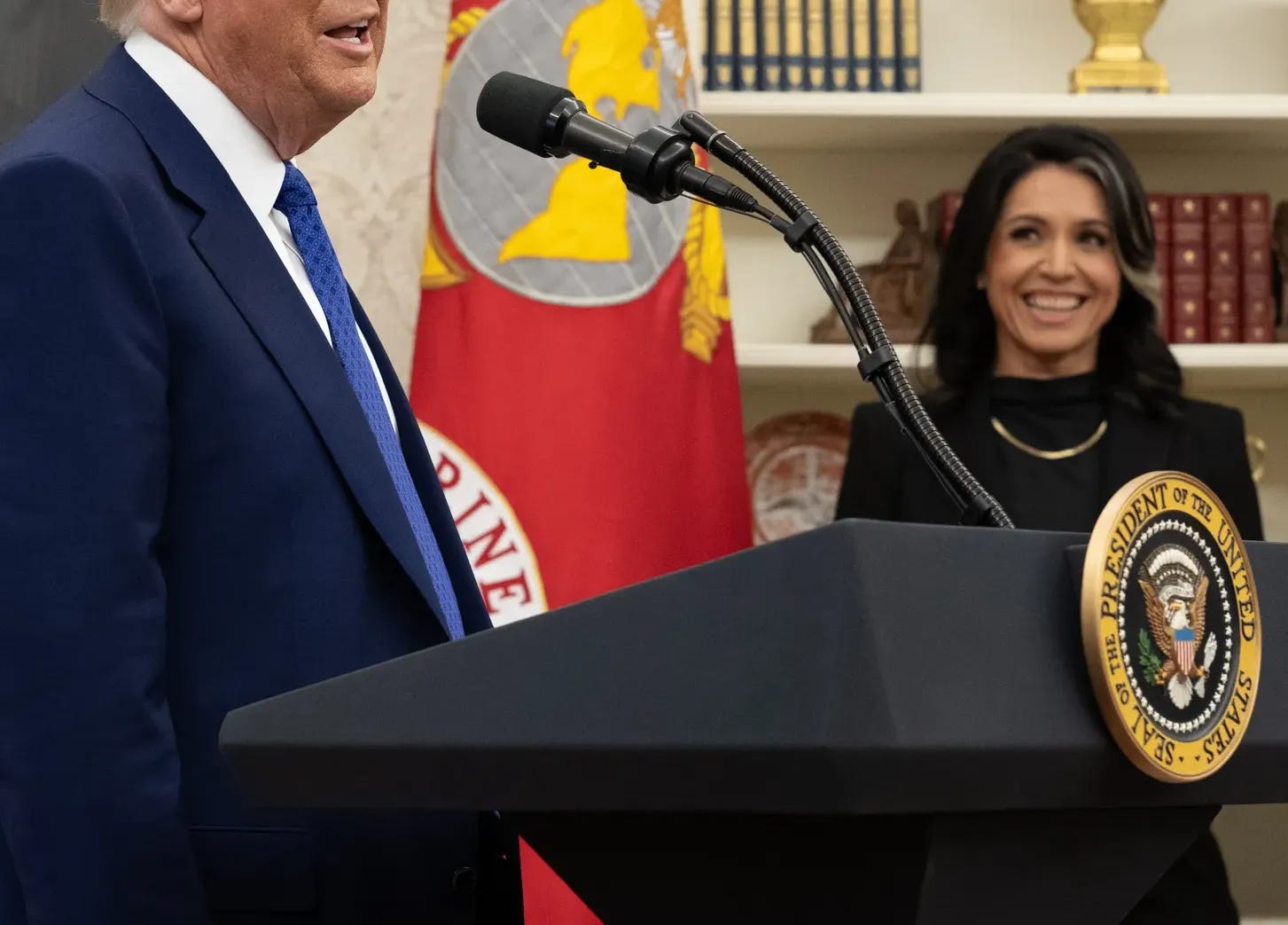
When a whistleblower complaint finally reached Congress this week after an eight-month delay, lawmakers discovered something unusual: significant portions had been blacked out under claims of “executive privilege.” The redactions concealed names and other key information, making it difficult for lawmakers to evaluate a complaint alleging political interference with intelligence reporting.
The redactions concealed names and other key information in a complaint about alleged political interference with intelligence reporting. Even more unusual: the intelligence report at the center of the complaint was so highly classified that the Intelligence Community Inspector General, a former CIA covert action officer with Top Secret clearance, had to obtain special authorization just to read it.
What do we know about the complaint?
The complaint was received on May 21, 2025, via the Intelligence Community Inspector General hotline.
Update: The whistleblower’s attorney initially told The Guardian that in spring 2025, the National Security Agency detected an unusual phone call between an individual associated with foreign intelligence and a person close to Donald Trump. The Guardian later corrected its story, explaining that its source had misspoken: the call was actually between two people associated with foreign intelligence who discussed someone close to Trump.
The New York Times and the Wall Street Journal accurately reported that the call involved two foreign individuals discussing a person close to President Trump. The Times and Journal added that the call concerned issues related to Iran, according to people familiar with the matter. The Times reported that Gabbard restricted the intelligence’s visibility because of doubts about its credibility. Some intelligence analysts concluded the two foreign nationals were either gossiping or deliberately spreading misinformation.
According to The Guardian, Director of National Intelligence Tulsi Gabbard took a paper copy of the intelligence report to Susie Wiles, the president’s chief of staff. One day after meeting with Wiles, Gabbard instructed the NSA not to publish the intelligence report and instead ordered NSA officials to transmit the highly classified details directly to her office.
Before The Guardian made its correction, Gabbard’s spokeswoman, Alexa Henning, called its initial report “false” and said the paper’s source “lied to you.” Henning called the reporter, Cate Brown, “a total loser being used by your sources (likely Congress) to leak highly classified information.”
The conflicting accounts center on whether Gabbard’s restriction of the intelligence was based on legitimate credibility concerns or represented improper political interference.
What did the complaint allege?
The whistleblower’s complaint alleged two things.
First: Gabbard restricted who could view the highly classified intelligence report for political reasons, not legitimate classification/security reasons.
Second: The top lawyer at one of the other 17 US intelligence agencies, most likely the NSA, failed to report a potential crime to the Department of Justice, also for political purposes.
Who blew the whistle?
We know almost nothing about the whistleblower, except that they are an employee of the intelligence community. That’s by design. The intelligence community whistleblower statute is specifically designed to protect the identity of people who report wrongdoing while allowing them to communicate with Congress through secure channels.
The whistleblower is represented by Andrew Bakaj, who represented the CIA whistleblower whose complaint about Trump’s conversation with Volodymyr Zelensky led to Trump’s first impeachment. The Office of the Director of National Intelligence took the unusual step of attacking Bakaj in a post on X as a “partisan advocate with a documented history of advancing complaints against Trump-era officials.”
Does this complaint involve the White House?
The Trump administration has claimed “executive privilege” over portions of the document. That signals the White House is involved, according to Bakaj.
Executive privilege typically refers to the president’s power to withhold confidential communications from Congress or the Judicial Branch. (More on this later)
What’s so sensitive about this intelligence?
The intelligence report is so closely held that even Inspector General Christopher Fox, who spent years running covert operations for the CIA and holds Top Secret clearance, had to obtain “compartmented access” to view it.
In intelligence parlance, that means the information was restricted beyond Top Secret levels and requires a “need-to-know” to be “read into” the program. These are called Controlled or Special Access Programs. Think the CIA’s post-9/11 “enhanced interrogation” program or Lockheed’s SR-71 Blackbird.
Under normal circumstances, intelligence this sensitive would be restricted to oral briefings for the “Gang of Eight”—the chairs and ranking members of the House and Senate intelligence committees, plus the four congressional leaders.
The eight-month odyssey
April 17, 2025: The whistleblower first contacts the Intelligence Community Inspector General.
May 9: Gabbard assigns Dennis Kirk, a Heritage Foundation Project 2025 architect, as "senior advisor" to the Intelligence Community Inspector General. According to House Oversight Committee Democrats, Kirk sits in IC IG offices and attends meetings but reports directly to Gabbard rather than the Inspector General, raising concerns about independent oversight of ODNI.
May 21: The Intelligence Community Inspector General receives a formal complaint.
June 4: Acting Intelligence Community Inspector General Tamara Johnson, a Biden holdover, determined the complaint was an “urgent concern” under the law but could not determine whether the allegations appeared credible. Under the statute, an “urgent concern” involves a serious problem, abuse, or violation of law in US intelligence activities—or lying to Congress, concealing material information from Congress, or retaliating against whistleblowers.
June 9: After receiving “newly-obtained evidence,” Johnson issued a follow-up memo saying the first allegation did not appear credible, but she could not make a determination on the second. The whistleblower told Johnson they wanted to take their complaint directly to Congress, as the law allows, but could do so only after receiving security instructions from the DNI on how to do so safely.
No instructions came.
June 2025: Someone “administratively closed” the complaint at the Inspector General’s office, an unusual step for an urgent concern.
October 2025: Christopher Fox was sworn in as the new Intelligence Community Inspector General. He made getting the complaint to Congress a priority.
December 4, 2025: Fox discovered that Gabbard’s own General Counsel hadn’t even been informed of the requirement to provide security guidance—six months after it was first requested. Fox also reviewed Johnson’s determination and concluded she had applied the wrong legal standards, saying if he were evaluating the complaint today, he would “likely determine that the allegations do not meet the statutory definition of ‘urgent concern.’” He criticized Johnson for treating “complaints resting exclusively on inference, speculation, or unverified rumors” as urgent matters. However, because Johnson had already made that determination, Fox said he would respect it and prioritize informing Congress.
This week: Fox hand-carried the complaint to Capitol Hill. Members of the Gang of Eight could review it on a “read-and-return” basis in a secure facility—meaning they couldn’t take copies, notes, or files with them. Significant portions had been redacted under claims of executive privilege.
Feb. 7, 2026: The Guardian reports on the NSA intercept and Gabbard’s handling of it.
Gabbard’s explanation
Gabbard’s office said the intelligence required special handling, which took time. She claims no one told her about the requirement to provide security guidance until December, six months after the whistleblower requested it.
That explanation creates a problem: Either Gabbard's staff concealed or mishandled the request for six months, she ignored it, or someone is lying. Senate Intelligence Committee Vice Chairman Mark Warner, D-Va., put it bluntly: Either Gabbard is completely ignorant of the law, her lawyers hid the truth from her, or they lied to her.
Gabbard said Saturday that she first saw the whistleblower complaint two weeks ago. Inspector General Johnson said she provided a copy to the DNI. Once again, someone isn’t telling the truth.
What lawmakers saw
House Intelligence Committee Chairman Rick Crawford, R-Ark., said after reading the redacted document that he agreed with both Inspector Generals’ conclusions that the complaint is not credible. He called the media coverage a “deep state” smear attempt against Gabbard, using “the same playbook” as Trump’s first impeachment.
Senate Intelligence Committee Chairman Tom Cotton, R-Ark., agreed the complaint was not credible and the matter was handled appropriately, calling it “just another effort by the president’s critics in and out of government to undermine policies that they don’t like.”
But Crawford and Cotton are reading a redacted version and declaring it not credible, which is like reading a book with pages missing and declaring it doesn't make sense.
Sen. Warner said the complaint was “way overly redacted, which makes it hard to draw a substantive conclusion.” Rep. Jim Himes, D-Conn., ranking member of the House Intelligence Committee, said he has ongoing concerns about the complaint and the delay in producing it and would continue to pursue it.
Executive privilege over intelligence reports?
This is where the Trump administration is breaking new ground and potentially rewriting the rules of congressional oversight.
The Supreme Court recognizes two main categories of executive privilege: privilege over presidential communications (protecting candid advice between the president and advisors) and privilege over state secrets (protecting military, diplomatic, or national security information that would harm the country if disclosed).
Neither category has traditionally been used to shield intelligence community whistleblower complaints from Congress.
Steve Cash, an attorney and former CIA officer who runs The Steady State, a nonprofit that advocates for the preservation of America's national security institutions, tells The After-Action Report that we’re in uncharted waters.
Claiming executive privilege over intelligence directly conflicts with congressional oversight established in the 1970s after revelations of CIA abuses, including the CIA’s involvement in Watergate, assassination plots, and opening the mail of US citizens.
When presidents have historically claimed privilege over national security information, Congress has pushed back hard. And privilege assertions have sometimes been used to hide wrongdoing, most famously in the Watergate scandal, where Nixon claimed executive privilege to conceal evidence of crimes.
What happens next
Andrew Bakaj, the whistleblower’s lawyer, said in a letter Wednesday that he has never received the security guidance needed to brief Congress directly. He gave Gabbard a Friday deadline to deliver the long-overdue security guidelines.
Failing that, Bakaj says he will provide an unclassified briefing for the House and Senate intelligence committees on Monday, February 9.
Late Friday, Bajak said he had not received any security guidance. “We are now moving forward with plans to provide an unclassified briefing to the committees and will be in touch with them on Monday,” Whistleblower Aid, the nonprofit where Bakaj serves as chief counsel, wrote on X.
On Monday, ODNI General Counsel Jack Dever told Bakaj that he had no legal right to go to Congress. Dever warned that briefing Congress could result in criminal charges, writing that "the highly classified nature of the underlying complaint increases the risk that you or your client inadvertently or otherwise breaks the law by divulging or mishandling classified information.”
The whistleblower's report is so heavily redacted that it barely makes sense, and some sections hidden for 'executive privilege', and access to it is on a 'need to know' basis, yet the report lacks 'credibility'?
This just has to be bigger than redacting reports….if it was only that, the committees would have been briefed……something juicy waiting to be leaked….