
The "40 Mike-Mike" Man
How Rep. Cory Mills went from contractor to arms dealer to Congress, thanks to a suspicious contract with the Iraqi government.

Editor’s Note:
In 2014, long before he became a Florida congressman mired in scandal, Cory Mills was living in a one-bedroom apartment in Arlington, Virginia, fending off HOA liens and foreclosure on the Florida home he bought with his ex-wife. Then he launched a new defense business that would change everything, vaulting him to sudden wealth and eventually to Congress.
In little more than a year, Pacem Solution International LLC, the firm Mills created with his new, Iraqi-born wife, somehow found itself in a munitions deal with the Iraqi government worth hundreds of millions.
Pacem’s partner in the $228 million deal was Chemring Ordnance, the Florida-based subsidiary of a 110-year-old British defense firm. Despite decades of experience making hand grenade fuzes and ammunition for the U.S. military, Chemring turned to Pacem Solution, a two-person startup with no track record that couldn’t keep its paperwork in order.
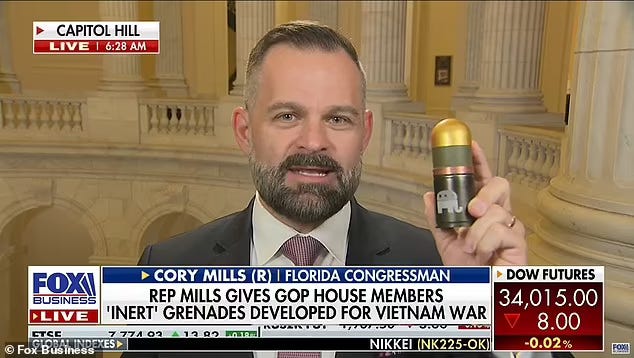
The contract involved 40mm grenades—known in the military as “40 Mike-Mikes”—and Pacem would claim credit for delivering millions of them to Iraq.
Pacem’s role in the weapons deal, which was first reported by Business Insider, remains murky. To this day, it remains unclear who introduced Mills and his wife, Rana Al Saadi, to Chemring, or how Pacem was invited into a procurement process that typically favors established defense firms.
Mills, Al Saadi, Chemring, and Pacem (which restyled itself as Pacem Solutions, plural) did not respond to messages left seeking comment.
I’ve been tracking Mills and his mushrooming scandals for months, tipped off by Army vet Bobby Oller, who’s been researching the congressman’s past. But no one could explain the central mystery: how a guy with no defense contracting credentials landed a munitions deal with Iraq out of nowhere.
To trace Mills’ rise, I spoke to a former contracting officer, an attorney specializing in weapons deals, and a veteran arms dealer. I also combed through military contracts, Iraqi audits, financial records, internal bank documents, and news articles. Together, they suggest that Mills’ rise had little to do with merit and everything to do with exploiting corruption by cutting corners, navigating a world where palms had to be greased, and riding a dubious arms deal into power.
The 45-year-old congressman said he started Pacem because he had grown disillusioned by military contracting. “I did not like how the money was being allocated and sometimes wasted,” he told a reporter in 2018.
Auditors in Iraq would later accuse Pacem of doing just that.
The Deal that Made Him
To navigate the opaque world of Iraqi contracting, Mills had a valuable asset: his wife and business partner, Rana Al Saadi.
After earning an English degree from Baghdad University, Al Saadi did a stint as a translator for the U.S. military in Iraq. In 2008, she immigrated to the United States and worked as a cultural advisor to the State Department. In one of the stranger subplots first reported by The Blaze, Mills and Al Saadi were married in 2014 by an imam reportedly linked to fundraising for Hamas and the Muslim Brotherhood.
Not long after, Pacem landed a huge break. On August 11, 2015, as ISIS overran Iraq, Pacem Solutions and Chemring Ordnance signed the $228 million contract with the country’s Ministry of Interior.
Pacem Solutions didn’t make weapons. It was an arms broker, essentially a middleman in the weapons trade. Brokers arrange deals by connecting buyers and sellers, negotiating terms, transporting weaponry, or organizing the logistics. (A separate company founded in 2015, Pacem Defense, is registered as an arms manufacturer and exporter.)
While the exact terms of contract F-9/2015 weren’t public, the deal was a direct commercial sale, meaning it bypassed the stricter oversight required in foreign military sales overseen by the U.S. government. That kind of arrangement practically invited abuse, especially in a ministry infamous for corruption.
A few years earlier, Iraq’s Interior Ministry spent nearly $120 million on thousands of fake bomb detectors, metal wands that were actually repurposed golf ball finders. A British company secured the deal through bribes; its CEO was sentenced to prison, and several Iraqi officials were also jailed. The Interior Ministry’s inspector general found that 75 percent of the contract’s value went to kickbacks, according to a report by the Office of the Special Inspector General for Iraq Reconstruction (SIGIR).
A veteran arms dealer with experience in Iraq told The After-Action Report that Iraqis were notorious for demanding payments, sometimes in cash, in exchange for signing contracts. The dealer mentioned that he had a contract in Iraq, similar in size to Pacem’s, which fell apart after the cousin of the official who signed the end-user certificate demanded a $1 million cash bribe the next day.
“The only way someone with no track record like Cory Mills ends up in the middle of something this big,” he said, “is if somebody got paid. There’s no other way.”
“This deal stinks,” the arms dealer said.
